
We lesbian, gay, bisexual and transgender folks are blessed. Really? Aye, it’s a real mixed bag out there. We gain some victories but we are still pariahs in too many places in this world. Still, I assert, we are blessed. I say that on no less an authority than Jesus.
Jesus has very radical ideas about what blessedness is. Even a quick reading of the Beatitudes in Matthew 5:3-11 will reveal this radicalness. “Blessing are those who mourn…” Yeah, right. “Blessed are the meek…” Really? “Blessed are you when people revile you and persecute you and utter all kinds of evil against you falsely…” Hmmm. That sounds like the way fundamentalists treat us, but that doesn’t make us feel very blessed.
The Beatitudes are radical and challenging. That’s why few Christians use the Beatitudes as a rule of life. It is a lot easier to follow the Ten Commandments.
Don’t be too quick to write off the Beatitudes as pie-in-the-sky ideals that only the most holy mystics can obtain. Remember that Jesus spoke these words to rough, poor, politically oppressed people. They lived hand to mouth at best and had no time for bleeding heart idealism.
Also, Jesus didn’t speak these words in English, like duh! Nor did he speak them in Greek, the original language of the New Testament. He spoke them in Aramaic, the common language of the people of Middle East at that time. So we have Jesus’ words translated from Aramaic to Greek to English. There are a number of scholars who have translated the Beatitudes from Aramaic to English, seeking to bring out the underlying poetry and depth of meaning found in the Aramaic. Among them is Neil Douglas-Klotz on whose work I base some of this article.
I am starting a series where I will work with one of the Beatitudes, bringing out the Aramaic meanings. That’s the part based on Douglas-Klotz work, in particular his book, “Prayers of the Cosmos” and his CD set, “the Healing Breath” I will also reflect on how the Beatitude related to the life we LBGT people experience.
The first Beatitude in English is, “Blessed are the poor in spirit, for theirs is the kingdom of God” Mt. 5:3. I will be focusing on the Aramaic word for poor, for spirit and kingdom. The Aramaic word for poor is meskenaee. Among its meanings are, “a solid home base” or “resting point.” Also, to hold onto something as if one were poor without it. The Aramaic word for spirit also means “breath.” This also true in Hebrew and Greek. The Aramaic word for kingdom refers to the power to do, the “I can” of God.
So, one possible meaning of this beatitude is “blessed are those whose breath is their home, who know their breath is their first and last possession, they will experience the ‘I can’ of God.”
What this means in real life is that the breath is a pathway to God. This is not a funky New Age idea, but one found in all wisdom traditions. There are many meditation practices based on breath awareness. For Christians we apply breath awareness with the knowledge that God is giving Herself to us in and as this breath … this breath … this breath.
I practice breath awareness by breathing in God’s life, God’s breath; God’s own self with the in breath. On exhale I release myself into God, release tension, worry. I simply relax in God.
This is a simple practice that can be done anywhere. If you are getting bored in a meeting, breathe in God, present in that meeting, present in the people in that meeting. Breathe out whatever is needed for you and or others in that moment in that meeting. If you are driving and the traffic is backed up, breathe in God, present with you right there on the road. Breathe out mercy and loving-kindness into your frustration.
Jesus is saying God is as close as our own breath, indeed the breath within the breath. It doesn’t matter who you are, gay, lesbian, straight, bisexual, transgender, God is there with you. Blessed are they who know this.
How do you come to know this? Find those practices that open you to the divinity of each moment, every moment. One of those practices is breath awareness. I will write about others in future columns.
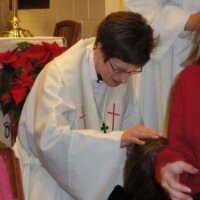
Registered nurse, Episcopal priest and lifelong Idahoan Rev. Deborah Graham helped found Integrity Idaho and served in the Diocese of Idaho as a supply priest, hospice chaplain and missioner to the Hispanic community. She earned a master of divinity degree from Church Divinity School of the Pacific.