
It was 1994 and I was a seminarian serving as the Legislative Aide to the House of Bishops’ Committee on Constitution at the General Convention in Indianapolis. The chair of that committee was William Wantland – the then Bishop of Eau Claire – and he provided what was arguably the most memorable (to me) moment of GC1994 when he took time from the business of convention to explain to me why I could never be a priest.
Thanking me for my work with the committee he went on to say that despite my “significant gifts for ministry” I could never actually be a priest because I was “ontologically incapable of being an efficacious bearer of a sacerdotal presence.”
Wow.
I’ll admit I don’t recall my immediate response to that pronouncement – and I also admit I had to go home and look up a few words to “unpack” what had just been said. I’d spent enough time “It Pays To Increase Your Word Power” in Reader’s Digest as a child to know what each of those words meant (more or less) individually – but strung together I basically had no clue what Bishop Wantland’s point was. I got the “what part” – he was telling me that the very essence of my being wasn’t up to being used sacramentally: that I was incapable of being an outward and visible sign of an inward and spiritual grace.
But it really wasn’t until I got some face-time the next semester with Thomas Aquinas and his Summa Thelogica that I finally figured it out “why part.” You see, Thomas, in his seminal theological treatise, offered explanations for almost everything: including where little girls come from. It seems the cutting edge scientific minds of the 13th century accepted the concept of something called the “homunculus” – which is defined as “a miniature, fully formed individual believed by adherents of the early biological theory of preformation to be present in the sperm cell.” The theory presumed that each sperm contained a perfect “little human” that was deposited by the father into the mother. Dad’s part was done at that point – so if something went wrong with the pregnancy it was clearly on Mom’s watch. That was the biology of the day – (hang in here with me: I feel a little like Ron Reagan trying to explain embryonic stem cell research to the Democratic National Convention!) – and it was Thomas Aquinas who went one step further and used that biology to inform his theology.
The problem he faced was the “imago dei” one – the “image of God” part. For if human beings were created in the image of God – who was, of course, male – then the perfect homunculus was also necessarily male. (And now it’s time for the “where do little girls come from” part. Ready? It’s really very simple.) Thomas declares – in the Summa Theologica – that females can therefore be explained as flawed males: and he posits that the cause might just be “an ill south wind blowing at the time of conception.”
And suddenly – in the middle of my second year Major Christian Doctrines class – I figured out Bill Wantland’s concern. Of COURSE he didn’t think I was ontologically capable of being whole enough – HOLY enough – to preside at the Holy Mysteries. It makes perfect sense – or at least it does if you’ re willing to base your theology on 13th century biology. If women are actually just flawed men then they really CAN’T “live in to the full stature of Christ” – in fact, one might wonder why we even continue to baptize them, poor things, much less consider ordaining them. We might even want to start adding a footnote in the psalter to the “thou art fearfully and wonderfully made” part that would say “except for those of you defective as a result of that ill south wind blowing at the time of conception.”
Do I overstate the point? Of course I do – but then that’s the point of a “blog” I think: so those of us who plan to die with no unexpressed thoughts have a place to overstate them.
Nevertheless, in this week-where-we-celebrated-the-30th-anniversary-of-the-ordination-of-women I hope we can be given the grace to recognize how far we have come as a church – and as a culture – since those courageous eleven women marched down the aisle of the Church of the Advocate in Philadelphia. In presenting themselves for ordination to the priesthood, they became icons of the ontologically capable. They helped the church take one giant-if-creaking/groaning/arduous step forward in the process of healing itself of centuries of the misogyny that has infected it: the impact of those whose theology is based on outdated and unexamined biology.
I had the amazing privilege of marking that occasion by standing behind the altar at All Saints, Pasadena on July 29, 2004 – con-celebrating the Holy Eucharist with my sister-priest Wilma Jakobsen for a congregation that included George Regas – rector emeritus and visionary voice in the struggle for women’s ordination. And I saw in my mind’s eye a whole parade of saints passing by who had made this day possible. I saw the women – lay and ordained – whose work and witness gave hope and offered inspiration: the men whose vision, partnership and advocacy helped move mountains and make miracles. We were celebrating a whole communion of saints whose witness had made possible the “Philadelphia Eleven” stepping out in faith 1974 – and all those who had come since whose ministries have so enlivened and enriched the work and witness of the church. Barbara Harris, Carter Heyward and Carmen Guerrero. Liz Habecker, Elizabeth Kaeton and Jane Holmes Dixon. Ontologically incapable, my eye!
And yet, if we base our 21st century theology on 13th century biology, that’ s the conclusion we – like Bill Wantland – will reach. What, I want to know, is the point of inheriting a tradition that balances scripture, tradition and reason if we refuse to apply our God-given reason to our theological discourse? Excluding over 50% of the baptized from full inclusion in the Body of Christ based on 13th century biology makes no sense whatsoever to me – nor does the conclusion that ANY child of God is created anything other than “fearfully and wonderfully” by the Creator who loves them.
Old news? A “done deal?” Not to those in the Diocese of Fort Worth where what is commonplace to most of us in the Episcopal Church (the inclusion of women in all orders of ministry) is still a dream far from being realized. Not to the faithful remnant of loyal Episcopalians I met with in Fort Worth who are still working and networking, praying and striving in that diocese to make “The Episcopal Church Welcomes YOU” signs outside their church buildings apply to everyone. Not to those who have courageously stepped forward and established “Integrity Fort Worth” as a chapter-in-formation – who invited me last weekend to come celebrate with them as they embark on this witness to God’s inclusive love to those in such desperate need of it.
And so in the same way my mind’s eye conjured up that parade of saints of those whose vision, courage and prophetic witness made the recent 30th Anniversary of the Ordination of Women celebration possible, I hold in awe and thanksgiving those here-and-now saints laboring on behalf of the Gospel in the Diocese of Fort Worth.
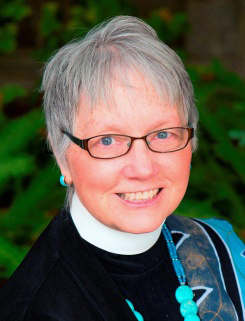
Los Angeles native Rev. Susan Russell serves as assisting priest at All Saints Church in Pasadena, Calif., and as Canon for Engagement Across Difference on the bishop’s staff in the Diocese of Los Angeles. Active in LGBTQ and women’s issues, Susan served as president of Integrity USA (2003-2009) and continues to serve as convener of Claiming the Blessing. A founding member of the Human Rights Campaign’s Religion Council, she has also served on the National Clergy Advisory Board for Planned Parenthood and as a member of the Task Force for the Study of Marriage for the Episcopal Church. In 2018 she began co-chairing the Episcopal Church’s Task Force for Communion Across Difference.