
I’ve so far avoided talking too specifically about family members. I’m overly self-conscious about what is and isn’t my story to tell. My family is a group of private folk, very nearly to the point of being secretive. It’s not entirely healthy — or pathological, for that matter — but it forces me to hold back on what I write about my siblings. It’s just as well. With the age differences between us, I don’t really know them. I know some facts about them, but their lives are largely mysteries to me. But my mother. How can I not write about Mama?
There’s no denying one thing. Mama was the most important person in my life. She easily had my greatest allegiance and I would have done most anything for her. She was my anchor and my tether for the first 30 years of my life.
I’ll start with some facts about her. Mama was born in January of 1921, the youngest child her father would sire but not the last her mother would bear. Her father died of an undetermined illness when she was three or four. My grandmother re-married, bore one more daughter, but this second husband died young also, probably of a heart attack.
My mother, therefore, grew up in a single-parent household through the Depression, before there was much, if any, public assistance for such circumstances. She didn’t talk a lot about her childhood, but I do know that her family lived in a house with a dirt floor and unfinished walls. I imagine it was your basic shack. Her brothers hunted for their meals. Mama remarked that if her brothers didn’t come home with a rabbit or a squirrel, they would do without meat that day, a difficult thing to accept in days before vegetarianism won popularity.
She walked to school with her siblings and other children in the countryside. She told about some Mexican children from whom she learned a few Spanish words and to whom she taught a few German words. Her best friend, who would remain such throughout most of her life, grew up on the farm next to her family. After they were grown, they became step-sisters when my grandmother married one last time, to Mama’s friend’s father.
Mama’s education ended at the ninth grade, where the local Friendship community school stopped. Actually, as I type this, I’m not sure that’s correct. I know Mama’s education stopped at ninth grade, but she may have been able to attend high school in Giddings one year. At any rate, it was impractical to get into Giddings everyday, so she didn’t go any farther.
I know that for a short time, before she married my father, she worked in some office in Giddings, but I don’t know what kind of office it was. She married Daddy on All Saints’ Day, 1939. Some time in late 1940, she carried to term a girl who was stillborn for reasons they didn’t determine. In December of 1941, my mother gave birth to my oldest brother.
Between 1941 and October 1963, when I was born, she had six more full-term pregnancies, one of which was another stillborn girl. Mama told me that this second stillborn child had a birth defect which made it impossible for her to breath. It had something to do with the air passage not being open.
So anyway, my mother raised seven children, four boys, three girls. I’m the youngest.
These facts of my mother’s life don’t say a great deal about her, of course.
I’ve often called Mama the goddess of practicality. Growing up in the Depression will do that, I suppose. We grew up in a household that knew how to do without. I never thought of my parents as tight with money, but they certainly knew how to stretch a dollar farther than you average American. I can still recall, within my lifetime, when we had only limited running water in our house. We had a working toilet, but no running water in the kitchen until I was nearly in school. We didn’t have a telephone until I was in high school. These modern conveniences were not considered priorities when it came to making sure the family was fed and clothed. While the hundreds of books and comics in my apartment will tell you that I’m not quite as practical as my parents, I suppose I have learned from them the lesson of prioritizing, sometimes against the larger culture. I own neither microwave nor VCR, two items that seem to be considered necessities in many American homes.
We didn’t go to movies as a family. I went as a teenager with the church group, but my parents never went. They held memories of people during the Depression going to movies when their family didn’t have enough to eat. This greatly offended their sense of priority. They never discouraged us from going and even encouraged some of it for the social aspects. It wasn’t an absolute moral stand against them, by any means. They themselves just never went.
Food was one place we never lacked. Growing up on a farm meant we always had food, even if we didn’t have a telephone. We raised our own pork, beef and poultry and my mother had a large garden every year. We milked our own cows. Those were much less health conscious days and we ate richly: fried foods, foods in real cream, cakes and cookies were ever present in the house. We never kept soda water or candy bars in the house, but we also never lacked for sweets.
Mama’s practicality made her an excellent mother at the doctor’s office. She wasn’t one to worry excessively but neither did she like mystery when it came to her family’s health. She had a way about her that won doctors’ respect and she was able to get them to explain what was going on in terms she understood. She always said that if a doctor wouldn’t explain something to her, she would have found another doctor. (This was obviously not necessary since we had the same doctors for decades, but then we probably just lucked out with good doctors.) Mama mentioned more than once that she would have liked to have studied nursing and her calm presence and practical prioritizing would have made her a good one. Feedback I received during my hospital chaplaincy when I was seminary seems to say I inherited a portion of this. I am certainly less patient than she was, but I am glad to have whatever portion I have of her care-giving abilities.
When I am sick, even now, I cannot help but think back on the days when Mama would sit on the edge of my bed and pat my back or leg. She didn’t say anything, just sat there quietly, comforting me with her presence and her strong, farmer’s hands until I fell asleep.
Before I started school — and in the first couple of summers after I did — Mama would let me sleep as late as I wanted each morning. I had my share of insecurities even then and would cry if I woke up to an empty house. Abandonment issues? Not me. Anyway, Mama assured me that she wouldn’t run off while I slept and if she weren’t in the house when I woke up, she’d be no farther than the chicken house or the garden. I shouldn’t be scared. She then pointed out a small round pitcher, where she would keep milk for me. It was just the right size for me to handle. I could get my own cereal for breakfast. In this way, she taught me how to be independent. I don’t think I woke up afraid very often after that.
I trusted her completely. I could.
The trust was pretty much mutual. Being four years younger than my nearest sibling, I ended up playing alone a lot. I often joke that if you give me some blank paper and a pen, I can entertain myself for hours. This is not an adult development. I heard my mother tell someone once, “With the others, if they were quiet for very long, I had to go see what they were into. If I check on Neil, he’s back in his room coloring or playing with his puzzles.” I guess we early on learned to trust each other’s silences.
I also have to admit that this trust was probably only one of the benefits to being the youngest of seven. By the time I was born, my oldest sibs were grown. Indeed, my mother was a grandmother by then. I can’t but imagine how different the mother I knew was different from the mother my oldest sibs had. More than two decades’ experience in mothering must surely make for a more calm mother. I have to remind myself of this when I become envious that my oldest sibs knew her as a young woman and got to have her up to two decades longer than I did.
Her practicality played out in one way that sounds a bit like insanity. When she found out she was pregnant with me, she had a crazy kind of hope for me. Perhaps this was borne of the fact that her last child was eight years younger than the child before and she saw some hardship in that span. I don’t know, but she hoped that I would be twins.
How many women who find themselves pregnant at the age of 42 would want twins, especially after having six healthy children (not to mention one grandson)? Not many, I’d wager, but my mother thought twins might be fun and since I was so much younger than not only my sibs but also my cousins (who were also companions for my sibs), she thought it would nice for me to grow up with a playmate.
I gave her a hard time about that for years. I also apologized for the time, when I was around five or so, I asked for a baby brother or sister. I didn’t know what I was asking a nearly 50-year-old woman.
That reminds me of when she did turn 50. I was in school by that point and one of my second grade classmates asked me how old my mother was. When I said 50, she said something like, “Wow, your mom’s old!” I was suitably indignant and defensive on her behalf but it was also a bit of a shock to find out that a good many of my classmates’ moms were under 30. To confuse matters more, I had a nephew in the same grade and the woman he called Grandma, I called Mama. I repeatedly explained that we weren’t cousins and we knew who we were, relation-wise. One time, my mother came to pick me up from school when I wasn’t expecting her. (I usually rode the bus home.) One of my classmates told me my grandmother had come to pick me up. I told him I didn’t have a grandmother (another by- product of having older parents). Now, Mama was one of the ubiquitous classroom party moms so my classmates knew her by appearance at least. “Yeah you do,” he said, “she’s always at the parties.” I finally realized that he was, indeed, speaking of Mama. And I had another opportunity to explain my family relations.
As I grew older, Mama did what she could to encourage her youngest child with the creative impulses and imagination, but that was limited. We didn’t have resources for things like piano and art lessons, which is one of the great cosmic injustices because I actually wanted them. How many children had these things forced upon them? Easier to stoke was my interest in cooking and baking and I spent hours at her elbow in the kitchen. I showed an interest in her quilting and crocheting and she showed me a few basics of sewing. My interest in art brought me a few “how to draw” books and paint-by-number sets. It was as much as she knew how to do in a community that lacked models of people making a living in the arts. I was never discouraged in my artistic interests, but neither was it encouraged as anything more than a hobby.
I suppose it was during my junior high years that I developed my playful relationship with Mama. One little ritual I had I stole directly from Carol Burnett. It must have been very annoying. There was a recurring character Burnett played (Mrs. Whiggins? something like that) who was an incompetent secretary for a character played by Tim Conway. Whenever she did something to warrant Conway firing her, she’d give some speech about how much she liked working for him and end it with “And her love him so much,” punctuated with a squeaky kiss on Conway’s cheek. I loved doing this to Mama, especially when she had her hands in dishwater. Why she put up with it, I don’t know. I at least deserved a face of dishwater suds. The most I got as a rebuff was a complaint about the pitch of the kiss. “Oh son, that hurts my ear!” She’d grimace and I’d giggle.
That little running gag probably ran longer than it should have, but it is just one example of the type of thing I’d do to tease her. In the last years of her life, it continued at family gatherings when I would “tell on” my siblings. “Mama, Carol’s picking on me.” Or the time I was her ride at some family function and she was ready to go home. Someone commented, “Oh, are you leaving so early?” I answered, “Yeah, Mama wants to hit Sixth Street tonight yet.” Sixth Street, for those not in the know, is the party street in Austin, the main center of activity for The Live Music Capitol of the World. Mama gave me one of her playful frowns, which only prodded me on. “This woman wears me out. I can’t keep up with her at the bars.” She would have been in her late sixties at the time.
There’s one more story I want to tell, to give an idea of what my mother was like, before I move on to the next section. I was with Mama when she was talking to another mother. This other mother said she was glad summer was almost over so the kids would go back to school. Mama replied, in a way that wasn’t at all defensive and almost embarrassed for it’s emotion, “Oh I’m always a little sad when school starts. I like having my children around.” In this age when Roseanne-like put-downs are a standard means of communication between parents and children, I realize I was blessed to hear my mother say this.
I may have come into my mother’s life late, I may have been unplanned, but I was never unwanted.
Since I’m writing this for a periodical about sexuality and Christianity, I suppose I should write a bit about my mother’s relation to my faith and my sexuality.
Religiously, we were not a fanatical family by any stretch of the imagination. I’m the most susceptible to fanaticism and even I couldn’t pull it off very well beyond the reserved environment of German Lutherans. (Zeal is, after all, relative. Zealous I was, for a Lutheran. For a Pentecostal, I would have been a cold fish.) I certainly loved Sunday school and vacation Bible school and the like, but the most Mama did about that was take me. I guess my religious impulse pleased her, but she didn’t push it. Among the few children’s books we had, the religious titles were a minority. We weren’t a family of daily devotions or even prayers before meals or bedtime. Church wasn’t an every Sunday kind of thing.
Still, all seven of her children maintain church memberships, albeit at different levels of participation. I can’t say it was a home devoid of religious life. Mostly, we were taught by example that this church thing was important enough to do regularly, but not excessively. Something in my disposition took this rather ordinary exposure to church and turned me into the hyper-involved Christian I later became.
Sexuality is a more tangled thread, mostly because I have in my head a jumble of theories about the role of parents in sexual development. Back when I was trying to become heterosexual, I tried to make my parents fit the models of a strong, dominating mother and an emotionally absent father. This was the thing that supposedly caused homosexuality in male children. I could never make the accusation stick. Mama didn’t become a nurse because Daddy didn’t want her to work outside the home and Daddy didn’t hang out at the feed store as much as other farmers because Mama didn’t want him to end up one of the crowd that spent whole afternoons there, drinking beer and playing dominoes. In other words, they compromised for each other. I don’t think anyone could say that one completely dominated the other.
As much as it pains me to admit it, I was something of a mama’s boy. Early childhood found me feeling homesick almost anytime I was separated from her. I much preferred being with her in the kitchen than with Daddy in the barn or field. I was much more interested in reading Laura Ingalls Wilder to please her than I was to read Louis L’Amour, Daddy’s favorite. In my heterosexual wannabe days, I tried to reverse some of these things. I tried to learn to use a chainsaw and I read a couple of westerns. It didn’t occur to me that my interests might be because I was gay and not the other way around. The mama’s boy predilection clearly spoke (I thought and the propaganda of ex-gays supported) of confused gender identification and so I spent some time later in life trying to “correct” my interests.
My mother’s connection to my sexuality, therefore, is wrapped up in a tangled net of a clinging child, non- traditional gender roles and interests, and a few years of reading conservative Christian pop psychology that told me what all was wrong with me. Sometimes, I think I’d like to spend some serious couch time to try and unravel it, but for the most part I don’t think it’s worth it. It’s sort of like spending large amounts of research dollars trying to determine the primacy of the chicken or the egg.
There is this dream, a vivid dream, probably the earliest dream I remember. I was certainly pre-school and I would like to guess about the age of four although I have no way to prove it one way or the other. I think the symbolism is pre-sexually oedipal, which lends another layer to the confusing relationship between my mother and her gay son. The moon had set in out backyard. It was taller than the house, but smaller than the elm trees there. It was a full moon, round and pale yellow. I think my sisters may have been trying to distract me but I saw Mama and Daddy get on the moon. The moon was a big round bed because Mama and Daddy were lying down and covering up as if going to sleep. I ran to the moon as it was about to rise into the sky and climbed aboard. It was soft, spongy and my weight was the last straw, so to speak, since it began to collapse some under me. Daddy wanted to send me back to my sisters in the house but Mama helped me up. I can’t remember exactly, but I think the moon began to rise as the dream ended.
Several things about this dream fascinate me as an adult. First, I wonder if I’d absorbed enough imagery from television — even in the chaste ’60s when Rob and Laura Petrie still slept in twin beds — to make this dream something of a child’s literalist interpretation of a honeymoon. (Parents getting away from the children for a second honeymoon, the bed images.) Second, I wonder if I disturbed my parents in a similar manner in the transition from their bed to my own bed. Both of these seem likely and even a little quaint. I can’t help but be disturbed by the oedipal image of the son supplanting the father in a bed, of the mother choosing her son over her husband. I don’t wish to make too much of it because it was, after all, the dream of a pre-sexualized child. Still, there is enough there to serve as a template of my clinging to my mother. The question I’ve yet to puzzle out for myself is, what exactly does an oedipal dream mean in a gay child?
My mother died before I came to reconciliation about my sexuality, so we never had a conversation about it. Our relationship was so comfortable and reliable that I can’t think of any fight we ever had, any disagreement beyond an occasional, minor irritation and most of those were when I was a child and not getting my way. I wonder if I’d come out as a younger man if that would have created some tension in our relationship or if she’d have been reconciled about it with me. She certainly wasn’t the type to have tossed out any of her children, but I can see her disappointment making it harder to come home in adult life. Before I get too far into that speculation, I have to back up and wonder if I would have ever risked that disappointment by coming out while she was still alive. Given my strong desire to please her, I have to answer, probably not.
It is only since Mama’s death that I have begun to look at the shadows behind our bright life together. It’s not an easy thing, but necessary for me as a writer and artist to see the deep recesses as well as the shiny surfaces. I spent too long shining a bright light on my mother on a pedestal until she didn’t have a relationship to reality. By association, I then had an unrealistic image of myself and by comparison, everyone else’s image was unrealistically tarnished.
At the start of this writing, I called Mama my anchor and tether. I chose those words carefully because both could have positive and negative connotations. Since her death, I have often felt like a free floating element, without a tether to my childhood home. This sensation has made me realize how much I stayed near home because of her and how that’s affected my choices in life. Everything I’ve ever pursued — acting, for one example — that might have taken me away from her, I pursued half-heartedly. I don’t know that I could have made it as an actor, but I certainly never went to New York or Los Angeles to try. I may have turned to writing as my creative outlet as much because it was less demanding geographically as because its where my passion ultimately lies.
Mama was not a risk-taker. I believe this was her crippling, her scar from a Depression era, fatherless childhood. It made for a very safe, injury-free childhood for me and my siblings, but there are things we didn’t experience because of her caution. I did not learn to swim as a child because it was safer to teach us to stay away from water than it was to risk losing us in some freak accident while we were learning to swim.
I hope that doesn’t sound like my mother was a fearful woman. She faced, head-on, any number of obstacles in her life, from Daddy’s two bouts with cancer (and other health problems) to money management problems to he own health issues (diabetes, detached retina, finally cancer). Remember, she was the goddess of practicality. Fear isn’t practical. But safety is.
Growing up, I was never pushed or groomed to be a doctor or a lawyer or anything for that matter. Since I thrived on pleasing, I would ask Mama what she wanted me to be. She always answered, “We made our lives, you have to make your own. If we told you what to do and it was wrong, then you’d be mad at us. You have to know what you want to do.”
Having heard stories of those who were groomed since birth to be lawyers, I am grateful for the freedom they gave us. They could have pressured us to stay on the farm and I would have been very susceptible to it. The blessing, of course, had it’s frustrating side. Here’s a compressed example of the way a conversation on vocation might go with Mama.
Me: Wouldn’t it be exciting to get some cartoons published?
Mama: I guess so.
Me: You guess so? Wouldn’t you be proud?
Mama: I’m proud of you anyway.
Me: Well, do you think it’s a good idea to become a cartoonist?
Mama: You have to know what you want to do.
Me: But I don’t know!
Mama: Well you don’t, I don’t either.
And it would go along like this until I gave up. If I was persistent, I might get advice that generally followed a formula of “if you’re going to do this, you might want to think about this,” but it always ended with “but you have to know what you want to do” and “if I told you what to do and it was wrong, then you’d be mad at me.”
In other words, a lot of freedom but not much direction or encouragement, either.
For what it’s worth, I seem to have inherited this tendency toward reserved enthusiasm. I’ve been asked more than once if I get excited about anything. And I just realized, I was paraphrasing Mama when an actor friend was seeking my advice on whether he should start his own theater company or not. I basically told him, “You have to know what you want to do.”
We do become our parents. Even if we don’t become parents ourselves.
Despite my desire to keep this series relegated to my life through eighth grade, it’s easy to slip outside those boundaries with a topic like my mother. Her influence was too great on my life to relegate it to a small part. As I write this, she has been dead for six years and just last year, as I was contemplating a job change, I was missing her again as if she’d just died. Even if she’d only told me, “you have to know what you want to do,” talking to her, going through the process of getting her non-advice, would have been reassuring somehow. Maybe I got more out of those vocational non-counseling sessions than I realized.
I’m going to close with a dream I had about three years after she died. I’ve dreamed about my mother many, many times since her death, but this one stands out.
In this dream, we were in the house, wherein she raised seven children. Mama was sitting in her easy chair by the northern windows in the living room. Outside the windows, the sun was shining brightly and the gravel road was dusty, dry. The grass was yellow and brown. In other words, it was the farm in summer, my favorite season. (It was also the season of my gestation and my mother had mentioned that the summer of ’63 was especially hot, a miserable summer to be pregnant.) Inside the house, we sat in the half-light, no electricity in use to push back the shadows. The darkness of the un-air conditioned house was our best defense against the heat. I sat in what was Mama’s rocking chair, where she sat before we bought her the recliner one Christmas. It’s the same rocker that sits in my living room now.
This is how we often sat in real life: still, soft spoken, comfortable in each other’s presence.
And my mother was giving me advice on how to come out.
I don’t think the details of this conversation (what little I remember in the hazy “real life” after a dream) is important but the dream leaves in me a joy and a longing. It was a gift to speak with Mama about things never spoken about. It gave me a homesick longing for what I took for granted and will never come again.
It comes back around to grateful joy for the memory of having had it for even for a little while.
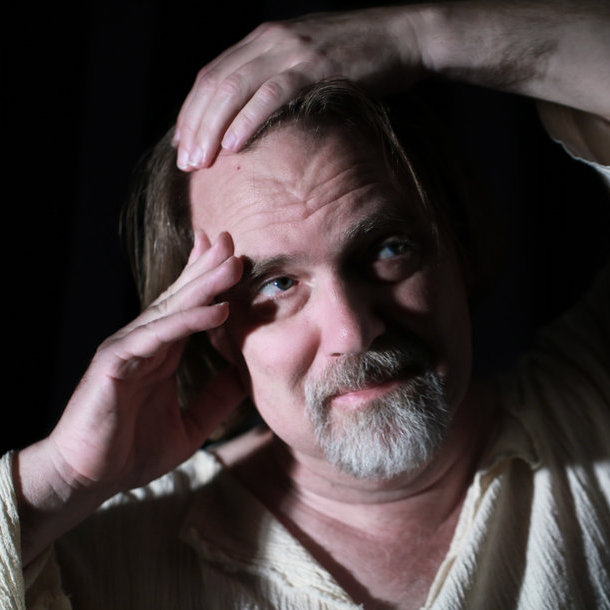
Central Texas native Neil Ellis Orts grew up on a farm on the Lee/Bastrop county line. He earned a bachelor’s degree in theater from Texas State University, a master’s of divinity from Lutheran Seminary Program in the Southwest and a master’s degree in interdisciplinary arts from Columbia College Chicago. He has published fiction and arts writing, including the 2004 novel Hidden Gifts. He also makes short performance pieces and has presented them in Chicago, Houston, and Atlanta.