
God and sex. One, I learned about through very intentional, formal instruction, the other, through hearsay and secret books and brief, embarrassed sections in health class. The connection between the two was implicit and vague but strong enough to stop conversation if one came up in the discussion of the other. At least, that’s how it was for me, growing up in rural central Texas in the 1970s.
My mother told me that I went to Sunday School before I could walk. My youngest sister (who is 16 years my senior) took me with her. I think she taught or helped with the preschoolers at our little country church. All I know is that I don’t recall a time when I didn’t go to Sunday school. It was a given in my life from my earliest memories.
I loved it. I recall a little girl who didn’t. She screamed as she was being made to go. She even got a spanking because she didn’t want to go. I didn’t understand her reticence because I was more likely to cry and pout if I was told I couldn’t go. I also wonder if that incident didn’t help foster my base assumption, as a child, that good children went to Sunday school and got approval for it. Bad children didn’t want to go to Sunday school and were punished for it. Looking back on why I loved it, I begin to suspect that my interest was more material than spiritual.
Let me explain something about my family. We lived pretty darn simply, in a lot of ways, and we didn’t get a lot of toys and extra clothes and what have you. Christmas was the time when we got new toys. On our birthdays, we maybe got one small gift and the cake of our choice (homemade, of course). We didn’t have birthday parties with tons of gifts, and we didn’t even dream of getting much stuff in between Christmases. The closest to regular toy acquisitions were the prizes in cereal boxes. Of course, we chose our cereals according to what was advertised on the lower corner of those boxes.
Now, we didn’t grow up in the Depression, so I don’t want to make is sound worse than it was, but when I see kids these days getting some toy every other trip to Wal- Mart, I have to wonder at what it’s like.
The connection here is that we got stuff at Sunday school. It may have been just a story leaflet, a page to color, maybe some small craft, but it was like Christmas every week. Acquisitive child that I was (was?), I delighted in these things. When I was cleaning out my bedroom closet, after my mother died, I came across a good many of these leaflets, especially the David C. Cook “Pix,” arranged in chronological order. These were no disposable entertainments but treasures to keep forever.
In addition to this childish greed, there was my constant craving for approval. I had a facility for hearing a story and remembering it. I received no little praise for retaining my lessons. This may have put me in opposition to my classmates, but in those days, I clearly favored the approval of adults over peers. I was that kid that raised my hand every time a question was asked, was disappointed if someone else was chosen, and delighted if that person was wrong so I had the chance to answer correctly. I was the kid you hated and wanted to smack and I didn’t care so long as I had the praise of the adults, the authority figures.
It wasn’t until I started this writing that I realized that my motivations for loving Sunday school. Ironic, I think, that the church originally had my allegiance by appealing to two of the Seven Deadly Sins, Greed and Vainglory. My fourth century heroes, The Desert Fathers and Mothers, would be appalled.
Of course, it has it’s up side. It kept me in church long enough to hear the Gospel and there are obviously worse alternatives for young people to get praise and stuff. I mean, I wasn’t an elementary gang member or anything. Still, it is true, to an extent, and vainglory would be a force in my religious education for some time. I especially enjoyed showing up other people with my mental retention tricks. I sat in the congregation at my youngest (four years my senior) brother’s public examination as he prepared for the rite of confirmation. I sat next to my mother whispering answers into her ear before the examined could answer.
I spent a good portion of my confirmation classes asking questions. Years later, Pastor Mgebroff would reminisce with me, telling me how I stood out in his memory. Of all the confirmands he taught in his fifty-something years of ministry, only one other student asked as many questions. “I could never just teach a lesson without you asking why,” he chuckled to me. Not that I’ve changed much.
Back then, I was working at and pretty much achieving the potential to become a seventh grade Pharisee. Answers were power and for this pudgy, weak kid, I sought power where I could and I found it, first, in authority’s approval, then in religious knowledge. Somewhere along the line, I either missed or ignored or wasn’t taught about “judge not,” because the thing I was most interested in knowing was the boundary. What was allowed? What was not? Where was the loophole? Ah, the power of the righteous over those who did the unallowable! This would explain why I remember more about the part on the Ten Commandments than I do about the parts covering the Creed, The Lord’s Prayer, or the Sacraments.
I shouldn’t paint myself as the untouchable pious kid. I was an adolescent by this point, regardless of my piety. There were spit-wads thrown and “smart remarks” tossed at certain adults and even a few dirty jokes passed. And when it came to my own public examination for confirmation, in the place of the pious third grader with all the answers was a seventh grader giggling incessantly throughout the evening, even snorting into the microphone once. (My best friend and I were more than a smidgen over the wrong side of the silly line.) I did not go home that night with the approval of my primary authority figures, Mama and Daddy. They didn’t do anything extreme, but they let it be known I embarrassed them.
All those adolescent indiscretions, especially the ones committed in the context of the confirmation class, made me sufficiently contrite and unworthy when our day of confirmation came: Palm Sunday, 1977. We stood in line in our white robes and discussed how no one in our class deserved to be confirmed. We were convinced that Pastor Mgebroff confirmed us because he was tired of us and wanted to get on to the next class, a group of four relatively quiet girls.
I guess we were relatively rowdy for a group of Giddings Lutheran youth in those days. There were 13 of us in all, seven boys, six girls. That’s a lot of raging hormones to be controlled by one pastor in his 60s. Still, I think I can say we all loved him and it was that love that made us so contrite on confirmation day.
From my vantage point as an adult, I make two observations about the confirmation experience. One: Whoever decided that puberty was the best time to teach our youth the fundamentals of the faith was a menace to the church and should have been locked up for the protection of all. Two: There is surely nothing more appropriately Lutheran than being confirmed with feelings of unworthiness, so I suppose it all worked out in the end.
Speaking of puberty brings up the other half of this essay, lessons in carnal knowledge. I want to be a smart aleck and say my carnal knowledge began with learning to eat because eating is certainly a fleshly concern. Of course, we all know what is meant by the euphemism. Carnal knowledge means sex. Well, here’s my sexual education, at least as far as the eighth grade.
I’m amused at the sitcom scenes wherein a father fumbles around with explaining the birds and the bees to his son, but not because the scenes are always amusing. The scenes are so far from my experience as to be a custom from another planet. I have no idea where my parents expected me to learn about sex, but it clearly wasn’t from them. This is an anomaly because my parents were usually very practical and proactive in other areas of instruction. The fact that they had seven children suggests they knew something of the topic. But no, I learned about sex where most younger siblings learn about sex: from older siblings. I have no idea where the oldest child gets his or her education.
I would like the record to show that being a farm boy helped not at all. I was practically grown before I even heard that farm boys were supposed to be more knowledgeable about sex because they grow up watching the farm animals “do it.” Not me. The bull mounting the cow was usually explained to me as the animals “playing piggy- back.”
That doesn’t mean that I didn’t learn about sex early, just not from the cattle. The brother closest to me in age (the one at who’s public examination I answered the questions from the congregation) had scored some pornographic paperback novels, I’m not sure how. These were my introduction to sex. I was in the third grade. There were no pictures in these books, so the education they supplied was limited, to say the least.
Here’s a few things that porn did not teach me about sex. One is that while porn is all about sex, it doesn’t have much to say about consequences. Let’s just say that I knew about sex before I knew where babies come from. I knew that babies came from their mothers’ bodies — I’d seen at least one sister-in-law in that state and made that connection — but I didn’t know what the father had to do with it. Honestly, I believed that when God thought a couple should have a baby, they did. (What simple faith!) This was cleared up for me when I asked my brother – – after pondering it a while — if he thought Mama and Daddy knew about this sex stuff.
Venereal disease wasn’t mentioned much in these books and if it was, it was simply embarrassing or a way to advance whatever slight plot the book may have had. Herpes wasn’t yet an issue and AIDS was still a word that meant “helpers.”
The female anatomy was poorly described. Colorful words were used, yes, but basically what I pictured was a second, deeper belly button, probably just below the waistline. When I finally saw a picture of a woman’s private parts, it made no sense to me at all.
And while these very heterosexual books didn’t teach me about homosexuality per se, they offered, in retrospect, a clue that I might be gay. I vividly recall a scene between two swinging couples. Following the spouse swapping, one guy is lying back in the afterglow, eyes closed, and he feels someone begin to fellate him. He opens his eyes to see both women smiling at him and he realizes that it’s his buddy who’s blowing him. The text made it clear that there was something Highly Unusual about this and the buddy explained, post-fellatio, that he was really just as normal as could be, but every once in a while liked to experiment. My question was, “what’s the big deal?” While I had some moral qualms about the whole sex thing in general, it seemed to me that if you were okay with multiple partner sex, why not same sex partners? In other words, the idea of male to male sex didn’t freak me out, even if it did so for the characters in the book. Yes, this should have been a big clue, especially since I have less vivid memories of the lesbian scenes, which seem a staple of the genre. In fact, I recall skipping past those.
It was inevitable that my sex education and spiritual education should collide, at least given the time and place in which I lived. It was probably inevitable, as well, that this collision would result in my burning my brother’s books, an effort, ostensibly, to save our souls. Mostly, it served my self-righteous attitude.
Early in all this sex education, I did engage in what I would call innocent sex play with some other boys. It satisfied curiosities more than any kind of sexual drive and of the three with whom I experienced this, two are married and apparently happily heterosexual. The third is not married and I pass no judgment on his sexuality as I really am in no position to say or guess. But this was all pre- confirmation and I hadn’t yet thought about the activity morally. I really don’t like to admit it or even think about it much, but if pressed, I’d have to say that those were some of the few really guilt-free sexual experiences in my life. Most (although not all) sexual experiences post-collision of educations are tainted with an obsessive self-examination of motives.
There is so much from my adolescent lessons of spirit and flesh that stay with me, in both positive and negative ways. I believe that the lessons imparted to me via confirmation and discussion of the Ten Commandments has given me a solid framework from which to approach sexuality and sexual activity. At the same time, so much of what I learned was decidedly heterosexual and stunted my sexual maturation process as a gay man. Coming out in my early 30s was like going through a second puberty. I felt like I had adolescent feelings in an adult man’s body. Sometimes I still do.
I’ve recently had discussions with different friends, both gay and straight, about sexual ethics. I find in my circle that sexual ethics range from whatever doesn’t get one pregnant or diseased is okay to the ideal of commitment before any sexual activity. I’m somewhere on that continuum, I’m sure, but I can’t tell you where exactly.
I guess my sexual education and my spiritual educations are still colliding. I confess I am a man of both spirit and flesh but really, I still don’t know how to talk about both God and sex in the same conversation.
Some things really haven’t changed that much for me since those farm boy days in the 1970s.
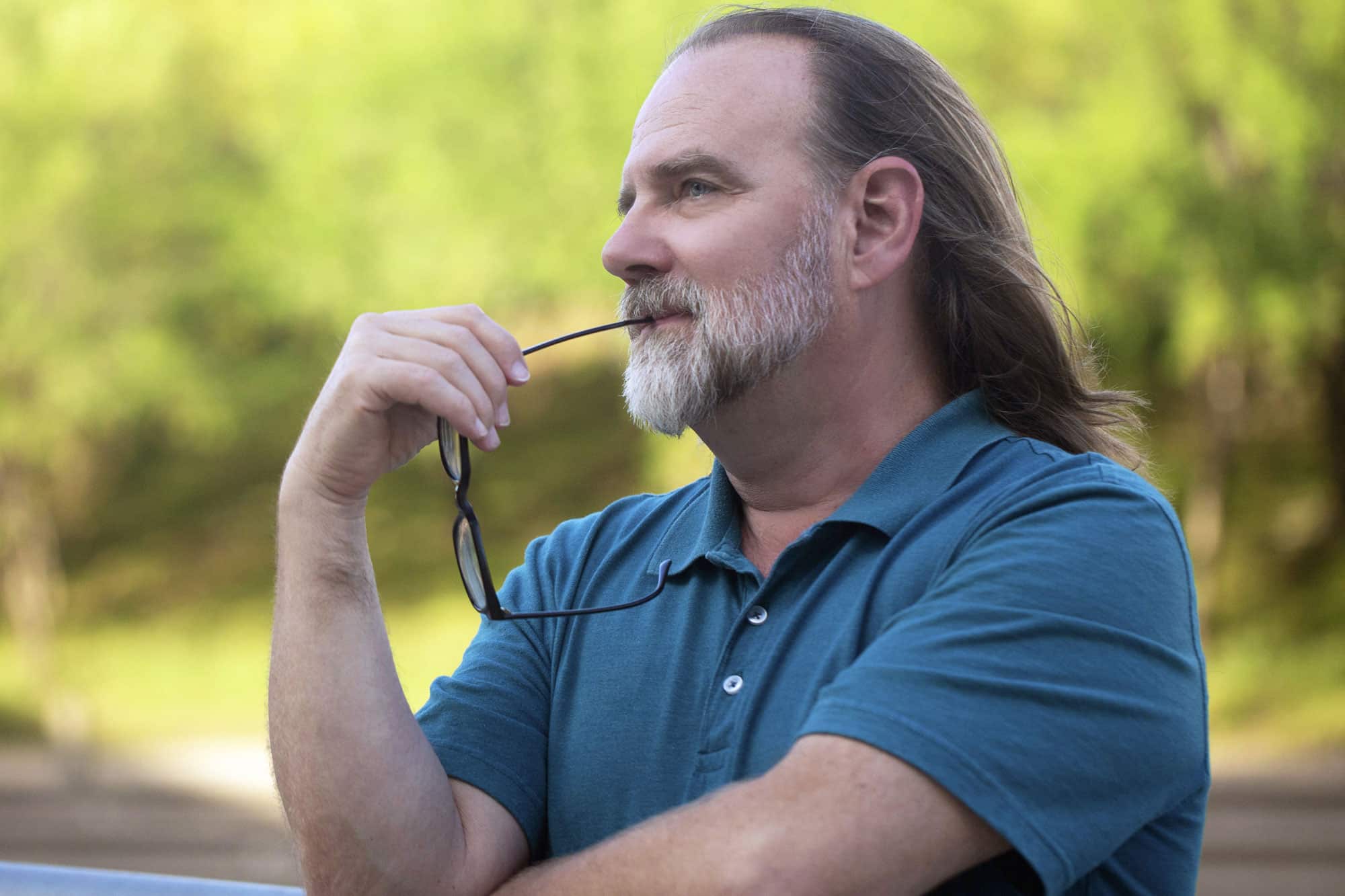
A writer in Houston, Texas, whose work has appeared in a number of small press journals and anthologies, Neil Ellis Orts occasionally writes articles on the arts. His novella, Cary and John, is available from Wipf & Stock Publishers.