
I remember two things about my first day of school. The first is this cockiness I had about going to school.
I didn’t start school with kindergarten, like most kids my age. At that time, at least in Giddings, Texas, one didn’t have to start school until the first grade. I wanted to go to kindergarten, let there be no mistake. I was anxious to start school because I wanted to know how to read. My mother, on the other hand, didn’t believe in pushing her children into the world any sooner than necessary. Since they didn’t teach reading until first grade anyway, kindergarten just wasn’t necessary. Also, kindergarten was only half a day, if I recall correctly, and it would have been a hassle to drive into town to get me at noon when the bus would take me to and from school when I started first grade.
So, all these very sound, very pragmatic reasons kept me out of kindergarten.
With cocky excitement, I went to school and found where the first grade classrooms were. There were three first grade rooms and they posted lists of students outside the doors. I didn’t know how to read, but I knew what my name looked like, which is exactly what I told the nice lady who stood behind me as I looked at a list.
“Here, let me help you find your room,” she said sweetly.
“I know what my name looks like,” I answered, without turning around. Obviously, I early on displayed testosterone ownership. I was insulted that she thought I needed directions.
Of course, knowing what my name looked like didn’t mean I knew how to scan a list. I had to look at each indecipherable name and dismiss it as not my own, a time consuming task. The nice lady finally helped me and directed me to my room.
Now, I don’t remember much else from that day except this: I threw up before the end of it.
I don’t know why, exactly, although I can venture a guess or two. One is that the cockiness and excitement quickly gave way to nervousness at the new surroundings. Thinking about it, sitting in a cafeteria of probably around 200 other children, was quite likely the largest crowd I’d ever been in, certainly the largest without my mother in view. I doubt the small church we attended at the time ever had a congregation that size on Sunday mornings. The only exceptions might have been weddings or funerals I’d attended by that point, but there I stayed close by my mother.
With uncertainty firmly settled into my head, I went home that afternoon to tell my mother that I had vomited and that I wasn’t so sure about this school thing anymore.
I also wonder about what vibes I was picking up from the other kids. Most of them had gone to kindergarten, including my nephew (yes, my nephew) who started first grade with me and was the only person I really knew there. Seeing as how I still get tense when I’m in a room of strangers who all know each other, the first day of school must have felt pretty awful for me at age six.
In thinking over my memories of first grade, I realize that there was a lot of fear wrapped up in the experience. I realize that no one intended it to be that way and I don’t know why it was so. Throughout my school years, however, I can see a pattern of excitement followed by uncertainty. I can’t explain why that is.
Here’s a memory: In my reading class, one of the pre-literate exercises had something to do with learning to recognize shapes of words. For example, if you drew a line closely around the word, “cat,” you’d have a different shape than if you did the same around the word, “dog.” With “cat,” you would have a tall shape at the end of the word while “dog” would have a tall shape at the beginning and a dip below the line at the end.
Understand so far?
Okay, so we were given an outline of a word and several words beside it. We were to circle the word that would fit in the outlined shape.
This was an exercise that didn’t seem to warrant much time because it was over quickly. The reason I remember it so well, however, is because I didn’t understand it at the time. Indeed, it was years later that I finally pieced together what I was supposed to have been doing that day.
Everyone was circling furiously and I sat there not understanding what to do. I glanced at my neighbor and he was circling words like crazy. (Maybe we were given the word and we were supposed to circle the corresponding shape. I’m not sure.) So what was I to do? I started circling everything on the page.
The teacher came around and looked at what I was doing. Oh my goodness! Caught! She looked at my circles, looked at my neighbor’s, saw that he had a clue and I had none. She asked what I was doing. I said I didn’t understand, tears welling up.
“You weren’t paying attention!” she declared. Having passed judgment and condemned me to my ignorance, she went on to something else.
My adult self looks back on the exercise as pretty stupid, really. The fact that the teacher went on without explaining what I did wrong and that I also learned to read without grasping the ambiguities of word shapes, both corroborate my suspicions about the effectiveness and necessity of the whole thing.
But I can still feel my first grader’s stomach bunch up just below my heart and I bet that if I tried just a little bit, I could still shed a tear over the incident. As I’ve written elsewhere, one of my great desires as a child was to be a Good Boy. Not paying attention was Bad. Being bad could get you all sorts of trouble that I wanted no part of.
In fact getting in trouble summed up the fear in first grade, if not my entire primary education. The little boy who would later become my best friend in high school (and who will kill me when he reads this) got in trouble one day and I remember it as well as he, maybe better.
The teacher asked who needed pencils sharpened. We were not yet trusted with the pencil sharpener on our own, so everyone who had a dull point got to stand in line and have the teacher sharpen the pencil. Now, I can’t explain the feeling of not needing a pencil sharpened, but there was something lonely about being one of those left sitting in our seats. Maybe we liked the grinding sound. Maybe we liked sharp objects and pencils was a good as it got.
Whatever the motivation, across the room came the much louder than expected, “SNAP!”
You should have seen the teacher’s head likewise snap. “I heard that!” she said. “Who broke their lead on purpose?”
There was a dreadful silence throughout the room. I think I blacked out because I don’t recall how she uncovered the culprit, but my friend was taken outside the room for a minute, leaving a room of first graders to consider the consequences of willful lead breaking. I’m not sure, but I’m willing to bet that my friend spent some time facing the wall that day.
That reminds me of the punishments hanging over our heads. This was a time and place when a principal still kept a glassy smooth wooden paddle, but I don’t recall it being used much in elementary school. (It was the punishment of choice in junior high, however.) Facing the wall was a fairly common punishment at that age. Depending upon the severity of the offense, we might have to face the wall with our arms held straight out, shoulder height. If we were Really Bad, a book might have been placed on each hand. If our aching arms began to droop, we were admonished to raise them higher.
Not everything about first grade was fear and punishment and vomiting. I have a memory of one time I got sick and my homeroom teacher walked with me down the hall very slowly, singing some unremembered song. Her oldest daughter was in my class and we were close friends throughout school, so I have many memories of this first grade teacher, of being in her home. This one memory of her is among the strongest.
And I did learn to read, a dream come true. Even better, I learned to use a library. What amazing joy to read stories on my own! No longer did I have to wait for my mother to have time, no longer did I have to beg my brother. It may seem redundant or even dumb to say, but whatever educational pursuit I’ve attempted since, none match learning to read as a desired goal or delighted accomplishment. The weekly trips to the library (school library during the school year, public library during the summer) were highlights of my childhood.
Those earliest trips to the library also have an ache in my memory. I have this heightened awareness of time passing, what I’ve come to call my sense of “never again.” An early example of this sense is in my tears over having to return books to the library. I just knew that if I turned in those books, I’d never see them again and I loved every one I ever checked out. There were even a couple that I recall trying to copy by hand, my attempt to hang onto those words. These tears and attempts at keeping the words are probably seed events for my current predicament of having shelves and shelves of books but barely any chairs for guests in my apartment. I also have a much used discount card for a local bookstore and a sadly neglected library card. That aching sense of never again is costly, at least monetarily.
I’ve mentioned throwing up a couple of times. I did that a lot in elementary school. Whatever made me nervous at that age would settle in my stomach and eventually be ejected, so to speak. (I pause to marvel at my being a chubby little boy.) For some reason, school parties were excellent opportunities for this. I suppose it wasn’t only nervousness but also excitement. Whatever it was, it certainly didn’t help that the drink served at these parties was Big Red or some variant thereof. I just remember this incredibly sweet, syrupy red soda being served along with cookies and cake and my inevitable rejection of their ingestion.
It got better as I got older. For most people, this would be a remarkably forgettable detail, but I recall the pride I felt at the end of third grade. I publicly vomited only once that whole year. I was growing up, indeed, becoming quite the big boy!
I more than made up for it the following year. I had a fourth grade teacher who made me more uncomfortable than a good many teachers put together, even that first grade teacher who called me inattentive and curbed our criminal pencil point breaking.
This teacher, now that I look back, was a master of shame. It helped not at all that she had known a long dead cousin of mine. This would have been the ’73-’74 school year and this cousin died in World War II! I and a classmate got silly during the singing of some patriotic song, one day, and while we both got in trouble, I was a particular disappointment since this cousin had died in active duty. It also helped not at all that my brother had been a special favorite of hers four years earlier. I always felt like I could never measure up to the standards he had set in her eyes.
So I threw up a lot that year. I also missed more school that year than any other year. My parents must have been as relieved to have that year over as I was.
In Giddings, we changed campuses at fifth grade, or at least we did in the ’70s. Now they call it “middle school,” but in those days we attended Northwest Junior High School. I was something of a smart aleck during those years. I suppose I should say it was during those years that I developed my smart alecky self. I became less afraid of the teachers and would tease certain ones to the point of being a pest. Still, I was smart enough to be excused my teasing, for the most part. With the possible exception of one teacher, I don’t recall any of them actively disliking me. I remember most of them fondly, anyway.
I was also something of a geek, a nerd. I read encyclopedias. We couldn’t check them out of the library, but one teacher had a set of the World Book in her classroom and she’d let us check out volumes to take home. She may have come to regret that since I sometimes corrected her in science facts. I naturally turned to her encyclopedias to prove myself right.
I’ve read of other comics fans relating similar stories, but my love of comics helped me both in my science studies and in my geekiness. Because I read a few stories about science fiction hero, Adam Strange, I knew about the star Alpha Centauri, before it came up in my science classes. I knew it was the closest star to our own sun and while it escapes me now, at the time I could have told you how many light years away it is.
It is somewhat surprising, given my interests in those years, that I didn’t pursue some scientific discipline. I had a period when I wanted to be a paleontologist when I grew up, but I think I chose that because I enjoyed telling people I did and then getting to explain what a paleontologist studied. It was part of my smart alecky showing off. I could have just as easily said, at other points, astronomer or botanist.
Junior high is the site of the inevitable onset of adolescence and the hormones that are a part thereof. I think I can say with some confidence that adolescence pretty much eluded me, especially so far as the sex thing went. I never got as excited about the girls as the other boys did.
I do think I experienced a crush on a teacher at that time, though. He was my biology teacher (science!) in seventh grade. He was just under 30, I guess. Slim, handsome, blond, and the hairs poking above his open collar fascinated me. Because I was a science fanatic, he seemed to like me, too. That year, he was certainly in the running for my favorite teacher.
He was also a coach. The following year, he became head coach at Northwest Junior High. I think it went to his head and in a bad way. For some reason, he seemed to think that it was important that he get 100% participation in the sports program from all the boys. I recall a day, early in the year, when he gave what was meant to be a motivational speech, to get us all excited about sports. I responded, in that classroom, in front of everyone, that not everyone liked sports, that participation in extracurricular activities like sports was a hardship for some of us farm boys (chores, you know), and that I had no intention of being on any sports team and that he couldn’t make me. I’m paraphrasing, of course. He was still a favored teacher and I wouldn’t have been so blunt then. I did, however, convey all the above sentiments.
He, in turn, conveyed the sentiment that I would never be a real man if I didn’t get on a team.
Needless to say, he fell mightily from my pedestal. What’s interesting to me about the memory wasn’t so much that he shamed me or even embarrassed me very much. I was silenced, but I recall sitting there and thinking, “You’re wrong.”
Simple as that.
I was so certain of his wrongness that the few times any classmate tried to tease me with any version of “Coach sure told you,” I didn’t get defensive, I just said that Coach was wrong and I wasn’t going to participate in sports.
I marvel now at that confidence. It certainly wasn’t a constant attribute of mine. Still isn’t.
That wasn’t the only time I had my “manhood” questioned, of course. I mean, I was a science geek who read comics, even drew comics, and showed only obligatory interest in girls. I did try to have a girlfriend, of course, because that’s what one did in junior high (and high school, of course). I always had friends who were girls, I just never managed any sense of urgency about having a girlfriend.
So I early heard the names, “fag,” “queer,” “homo,” and whatever else was used at the time. The crazy thing is, unlike what other gay men say in their memoirs, I don’t recall living in fear or even concern that it might be true. I was so sure of my piety at that age that the thought that I, of all people, would have any “deviant” urges (sexual or otherwise) was just ludicrous. (I say that despite some fairly innocent experimentation at the same time, but that’s another story for another time.)
I do have to share one last story about my junior high years, one that exemplifies the level of my naiveté at the time.
I was sitting in the eighth grade, earth science classroom and one boy leaned over to me and whispered, “Hey, Neil, I hear you give good BJs.”
I made him repeat it because I didn’t understand. Once I understood the words, I didn’t understand the statement, although I had a feeling it was something nasty. “I don’t know,” I said innocently. “What’s a BJ?”
My classmate was getting exasperated with me. “You know,” he said, “blow jobs.”
Despite having been exposed to more than one pornographic paperback novel by this time, I still didn’t know what a blow job was. In retrospect, even I am amazed.
So I asked, “What’s a blow job?” I had to find out because I still couldn’t answer his question about whether I gave good ones or not.
He explained it to me.
Now, here’s where it just gets silly. I recall entering into a debate over the naming of the activity. I completely ignored the original question and I recall neither disgust nor denial at the accusation. I focused more on the etymological oddity that something that entailed sucking would be labeled blowing.
I don’t recall him trying to engage me in that sort of conversation again.
My naiveté wasn’t a defense against the ongoing accusations, labels, and teasing. It was all very confusing, since I heard names that, technically speaking, apply to me but at the time, I didn’t always know what the words meant. (See above.) For this series, I’ve given myself the cut-off date of 1978 or eighth grade, but it should go without saying that the name-calling, whispers and rumors didn’t stop there and continued into high school.
Looking over what I’ve written, I can’t help but think of all the things I’ve left out. All the same, I’ve conveyed some of the important themes of my primary, public school career: The desperate desire to read, my nervous stomach, the interest in science, the questioning of my “manhood.” I didn’t talk about the preference to playing house to playing baseball or the teachers’ (occasional) insistence that I play with the boys. I left out the rough bus rides over gravel roads, during which I read books and gave myself headaches over trying to follow the jumping print. I haven’t mentioned too many classmates and my early feeling of not having many friends. These may all come to light in future episodes of these memoirs.
I’m left, however, with a question about my childhood, one without answer, but it stands out all the same.
In junior high, here were all these small-town-Texas cowboys/jocks, supposedly straight, and they had better gaydar than I did. How did they know what I could not name in myself?
Even more, why were they allowed the power to not only see it and name it, but also shame me into a silent repression?
Add it to the list of questions I have for Jesus when he returns.
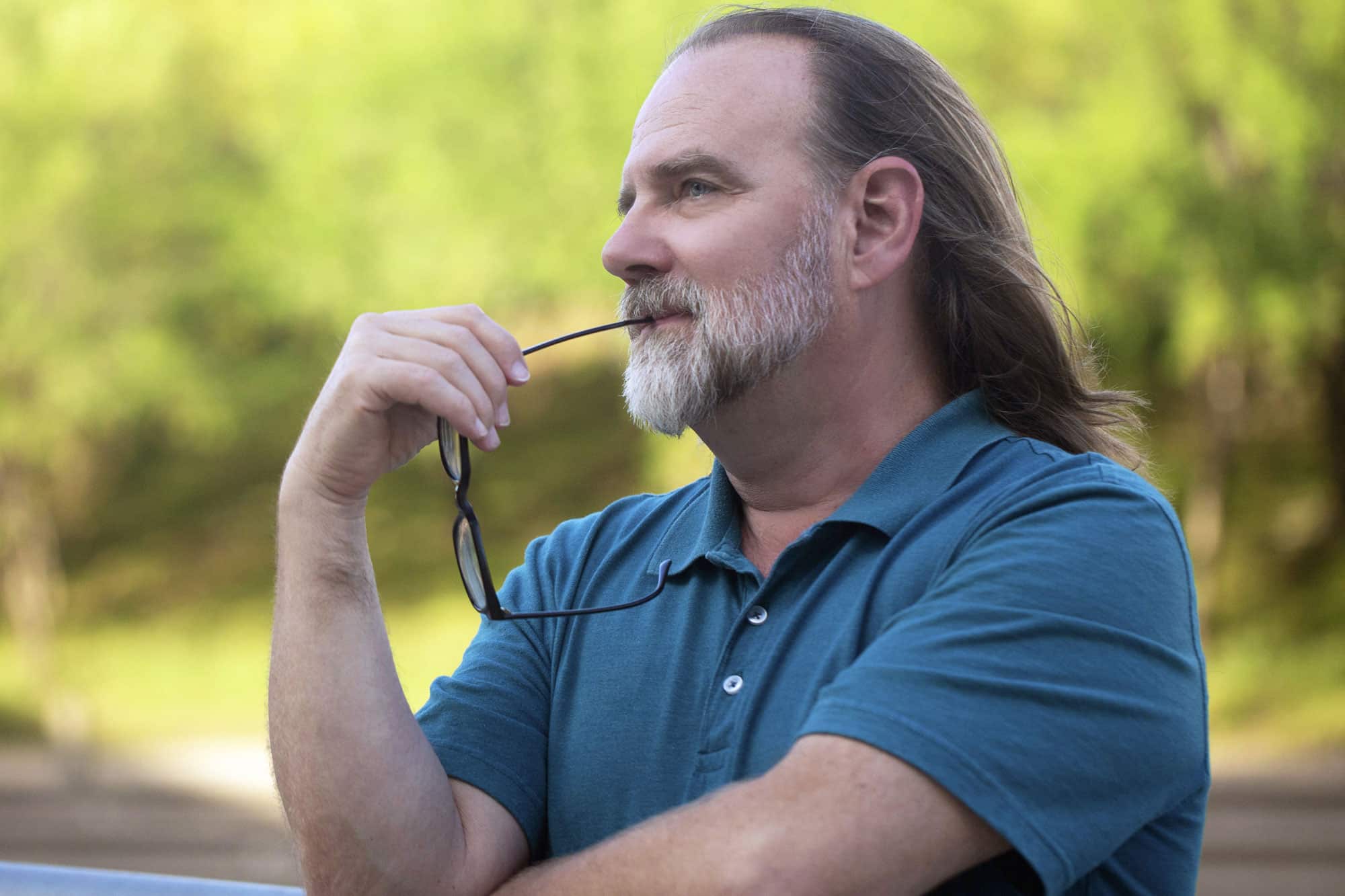
A writer in Houston, Texas, whose work has appeared in a number of small press journals and anthologies, Neil Ellis Orts occasionally writes articles on the arts. His novella, Cary and John, is available from Wipf & Stock Publishers.