
I come to the topic of forgiveness with some anger. It’s a bit of a sore subject right now. You see, I have these high, high ideals of how one should live a Christian life and I really mean most of them, but when I look in the mirror of my life, I see it’s this forgiveness thing that is my largest stumbling block.
I don’t forgive easily or well.
In part, I blame my family for this. It’s great to have a scapegoat and families are great scapegoats, so here we go. We are a grudge-keeping people, my family, actually my whole hometown to an extent. I think it’s part of the fabric of German Lutheran communities. Oh, we like to say, “It’s nothing, let’s say no more about it, it’s over and done,” but it’s just a way to keep silence on whatever issue is in front of us. Silence does not, however, bring peace. Look, I have two siblings who haven’t spoken since around the time I was born and the whole family kept so silent about it that I was a teenager before I realized — no, I was told — they didn’t speak. Okay, so we didn’t speak about this and it allowed for relatively quiet Thanksgivings, but when you get right down to it, I found it quite disturbing. We all did. My parents found it disturbing. When I finally was able to speak to some of my other siblings (there’s a lot of us) I found out that the whole family was pretty disturbed about this rift. (It disturbs me most because it makes me wonder what else we don’t speak about in my family, but that’s for another angry essay perhaps.)
Silence does not bring peace.
Knowing this doesn’t really absolve me of my own grudge-keeping. Having noticed the pattern in the family history should help free me from the wound in the family. I suppose to some extent it has, but not completely. I’m quite in bondage to this sin. Handy scapegoat or no, my family is not responsible for my sin and I need to find a way out of it myself. (I pause to speak to anyone who wants to give me a platitude about Jesus setting me free from this sin. Yes, okay, I think Jesus is the answer to getting out of this bondage, yes I believe Jesus sets us free. I’ll tell you this, however: The freedom I have in Christ is still a goal. It’s as if Jesus comes to the jail cell, opens the locks and says his patented, “Follow me,” and so I follow. But the way to get out of the cell block is through a tunnel littered with rotting garbage and fecal matter, overrun with rats and roaches and other slithery things, and I don’t even want to think about what that stuff is dripping from above. Call me cynical, call me angry. You’re right. And I’m just reporting what I see. The way to freedom is the way to go — should I say the cell was better? — but it is no place to take scenic Polaroids for the scrapbook, either. If your journey is easier, paved with rose petals and lined with lilac bushes, say a prayer of thanksgiving and let me get on with my ranting.) Anyway, this is what I know about forgiveness, from the point of view of being the one who forgives. It isn’t much, but it’s what I have today.
I don’t want to go about spilling my personal life to a world-wide audience, in part because the story isn’t all mine to tell. It will be better told in my fiction writing later, when I can disguise the people involved and so avoid libel. The details of the stories that follow, therefore, are going to be sketchy, at best. Watch for fiction with my name on it (write to the editors of the New Yorker demanding they publish some, would you?) to get the juicier versions.
It’s best to start out with saying this: The hardest thing for me to forgive is a lie. Oh, okay, I know about lying, little white lies that are about trying to cast things in a nicer light or even to avoid getting into trouble. We’re creatures of self- preservation, mostly, and I know how to bend the truth, too, so I come off looking better than I am. The lie that has me in an unforgiving mood these days comes from getting my hopes up. Someone told me something was happening that would have fulfilled one of my larger hopes and dreams, and that had me telling my 50 closest friends (or so) about this great thing in my life. Weeks later — weeks, not days, weeks that carried into more than one month — I’m informed it was all a lie.
The person at the center of this has asked for forgiveness, but try as I might, I’ve not been able to say, “I forgive you.” I’ve been able to say, “That hurt me a lot,” and I’ve been able to say, “I don’t trust you anymore,” but the best I can say with the “F-word” is “I want to forgive you and I’m trying to forgive you and I am forgiving you, but I’m not done with this grudge so I can’t yet say I’ve forgiven you.” I contend it does no good to stand there bleeding and say “It’s nothing.”
Conversely, it’s really hard to get your self-righteous jollies when you’re being honest and admitting to withholding forgiveness. “Stumbling block” doesn’t seem to cover this. Where are my high ideals for Christian behavior? They’re lying around here somewhere, amidst this bitterness. I’m sure of it.
Is it fair to ask for time in the forgiving process? I guess that’s not for me to answer just right now, but I don’t know how to get from wanting bloody retribution to saying “all is forgiven” in one simple step. I have enough tendencies toward passive aggressive behavior without pretending everything is okay when in truth I’m still rather sore and hostile.
I have this thing going with groups of people as well as with individuals. My friend, Joan, has asked me if I am angry at the church for telling me it’s not okay to be gay and there-by asking me to stay in the closet the entirety of my 20s. At first, I tried to be gracious and speak about the good things the church has done for me and not focus on the bad things. As time has worn on, however, I realize this is a little like having a mother who bore you, nursed you, dressed you well and bought you Reese’s Peanut Butter Cups regularly, but locked you in the closet for days on end while she went on a wild binge of alcohol and seedy men and sometimes seedy women. (Settle down. I’m not describing my real mother, who was a fine woman, married to one man for 49 years, raised seven fat children. I’m talking about the church.) All the good things are true, but so are the bad things. Forgiveness, in this case, becomes this feeling of disloyalty, of not being grateful for the good things, because even speaking of forgiveness acknowledges the bad things. It’s all very complicated and all you therapists out there who are inclined to work cheaply are welcome to contact me to discuss the unraveling of these feelings.
I’ve seen it written that forgiveness isn’t so much a feeling of reconciliation, a feeling that everything between two people is okay, but more a decision to not pursue revenge, a sincere desire that no evil befall the other. Where I saw this was in context of victims of violent crime or abusive relationships. If you’re getting beaten up repeatedly and the beater is asking for forgiveness, forgiving the creep doesn’t necessarily mean everything is okay, especially if you’ve heard the forgiveness line before and all it’s gotten you is beaten up again. This is not okay and you need to get far far away. Still, I believe in forgiveness, despite my grudge-holding, because I know my grudge-holding and vengeance-seeking eat at me like a cancer and only perpetuate the cycle of an eye for an eye. I honestly believe that forgiveness breaks that cycle and has more power to change the world than all the retribution we can fling at our beaters. If a position of wishing no harm is the best we can get to in breaking that violent cycle, then that is where we are and it’s not a bad place.
Besides, true reconciliation takes two people, two sides. To get to a place of happy co-existence takes a lot of hard work, a lot of trust-building and, well, a lot more work from both sides. Both sides have to want it a lot, want it very badly. Both sides have to be willing to sacrifice something of their stand and their pride to effect real reconciliation. This was brought home to me when I was talking to my friend Martha about this. I was expressing my frustration with myself, that I was unable to feel reconciliation with a certain friend who had hurt me. I had been asked for forgiveness, but I could not honestly give it. I still felt a wall. Again, trying to keep my troubles (and those of my friend’s) out of the public eye as much as possible, I won’t go into detail but she pointed out that I had very little assurance that the incident which hurt me wouldn’t happen again. There was little change in the behavior that caused the hurt, she observed. I asked her, should I then put conditions on my forgiveness? She said it isn’t so much putting conditions on the forgiveness as being cognizant of true repentance. Repentance means to turn from something, toward something else, something that is, hopefully, better. Asking forgiveness without repentance, she said, is really just asking for permission to continue in hurtful ways. I think my friend Martha is very wise, or at least very perceptive of human nature.
As I’ve reflected on my conversation with Martha, I’ve been superimposing her observation on what I previously believed about forgiveness and have come to a new, if tentative, understanding. I’d often said that forgiving someone doesn’t necessitate staying in harmful situations but should, instead, free us from expending the energy that vengeful thoughts and plans require. Forgiving someone is as much for the one hurt as it is for the one who did the hurt.
If the one forgiven, however, shows no sign of true repentance, that is to say, shows neither a turning from the hurtful behavior or at least a desire to change, there can be no true reconciliation. As I said earlier, it takes two to reconcile. Asking and granting permission to continue in the hurtful behavior is not reconciliation.
Forgiveness without reconciliation? It’s a stretch, I admit, but for the moment, it’s where I sit on this issue. I may come to understand, later, that this was just another justification for keeping a grudge. Today, of course, I say not. In fact, as I’ve written on this essay, searched through the anger and feelings of failure that compelled me to write about forgiveness, I have to say that in at least the one incident I vaguely outlined at the first, I wish no ill will for the person. In fact, I’ve come to realize that I truly do want some good things for that person. I think I have come to a point of forgiveness in that situation.
Have we come to a point of reconciliation? I don’t believe so. I still don’t trust the person in question. I still think there are destructive behavioral patterns that need to be discussed before reconciliation of any true depth can be achieved. What coming to this point of forgiveness has done for me, however, is given me a place of more peace where I can approach the situation with some greater measure of love and sympathy.
I may even be willing to sacrifice my pride and be willing to admit the places I need forgiveness, too. I may have touched upon a new way for me to seek forgiveness, from people and God.
It’s very hard to say. This forgiveness thing, like so much in our lives of faith and relationships, is a journey. I’m at this one point on the road and who can guess where it will end? I can only hope, at this point in my journey, that I will travel down the right path, the one that leads to better relationships, fuller and more real relationships with those around me.
Maybe one day, I’ll find my way through the anger and cynicism and finally be converted, finally be a Christian.
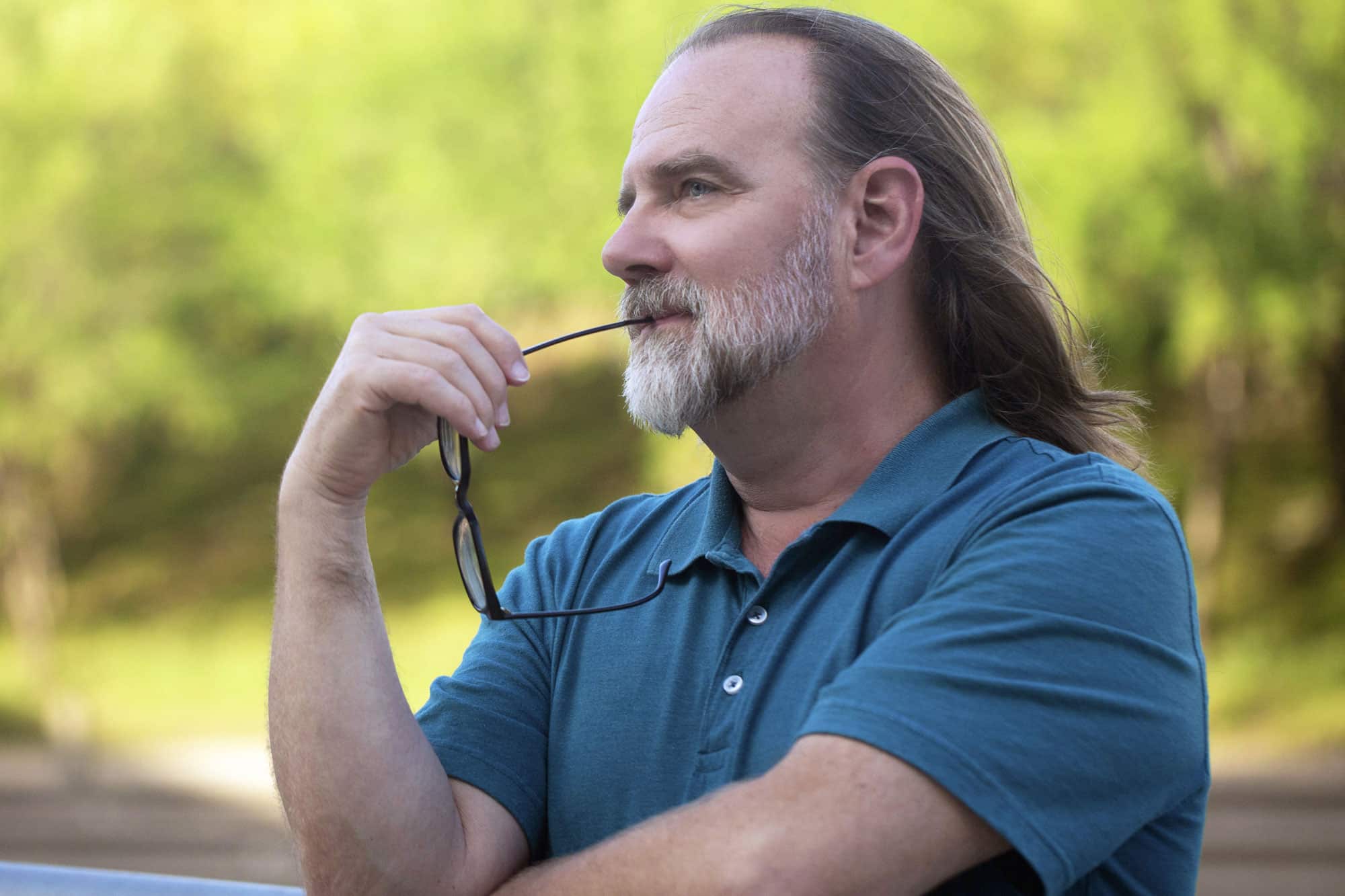
A writer in Houston, Texas, whose work has appeared in a number of small press journals and anthologies, Neil Ellis Orts occasionally writes articles on the arts. His novella, Cary and John, is available from Wipf & Stock Publishers.