
Stranger in a strange land
John Shelby Spong, the controversial Episcopal bishop who writes such provocatively titled books as Why Christianity Must Change or Die: A Bishop Speakers to Believers in Exile and Rescuing the Bible from Fundamentalism: A Bishop Rethinks the Meaning of Scripture, recently did a book signing and reading in Austell, Ga. — which is in Cobb County, infamous for its 1993 anti-gay resolution that stated in part: “The homosexual lifestyle is incompatible with the standards to which this community subscribes.”
Recently Cobb County, where I was born and still live (with my partner of five years), was in the headlines again for the anti-evolution stickers it pasted in thousands of textbooks, reminding students that evolution is “only” a scientific theory (you know, kinda like gravity). I was intrigued that, out of the eleven Borders bookstores in metro Atlanta, one of the most liberal Christian bishops of all time would do a book signing at a Borders in one of the most infamously conservative counties in America.
Bishop Spong was on tour to promote his new book, The Sins of Scripture: Exposing the Bible’s Texts of Hate to Reveal the God of Love. He explained that the title came from the publisher; his original title for the book was The Terrible Texts. The book is Spong’s critique of the biblical texts that have been used throughout history to oppress and subjugate women, gays and lesbians, children, Jews, other cultures, and even the Earth itself. The bulk of the book is spent in examining these texts.
Based on my readings of Spong’s earlier books, I went to the reading expecting to hear an intellectual attack on the “terrible texts.” What I experienced, though, was a look into the soul and spirit of a man who passionately loves the Bible and sincerely wishes to rescue it from those who would use it as a weapon to oppress others.
Spong was challenged several times by a man in the audience who just couldn’t understand how such an intelligent man could believe in a supernatural God. Spong’s response was that his faith is in a non-theistic God who is the source of life, the source of love — and in the words of Paul Tillich, the “Ground of All Being.” Our response to such a God, according to Spong, should be to “live fully, love wastefully, and be all that God intends us to be.” This was a phrase he used repeatedly throughout the evening, especially the “love wastefully” part. He also uses this phrase throughout his new book.
Spong also spoke about how his faith is grounded in his own experience of God, and how all of our images, creeds, and dogmas of God are pale, imperfect reflections of the very real “God experience” that people have had throughout history. The Bible, according to Spong, should be viewed not as a textbook or guidebook, but as an “epic history,” recording the sacred stories of the ancient Israelites and the early Christian church. In the pages of the Bible we can see their faith journeys, their “God experiences,” evolve and progress. We can also hear “minority voices” within the text, “protest stories” such as Job, Jonah, and Ruth, which challenge and disagree with the prevailing religious ideas we find in other parts of the Bible.
When asked if he prays, Spong spoke very movingly about his daughter who is serving in the military in Iraq: “Do I pray for her every day? How can I not?” He directs his prayer not to a supernatural being up in the sky but to the very Ground of All Being. He believes that his love for his daughter, expressed through his prayer, creates an atmosphere of love and protection for her as he prays for her safety and her soon return. He used the terminology of biologist Rupert Sheldrake in describing prayer as a “morphic field.”
In talking about praying for his daughter, Spong spoke about how we are all interconnected. He laughed and said he can’t talk about prayer without sounding “mystical,” something he avoids in his books. This “mystical” side of Spong did come through, to a small extent, in a recent interview with Beliefnet.
Unfortunately, this deeply spiritual side of Spong does not always come through in his new book. The Sins of Scripture offers a fascinating critique of biblical texts that truly are terrible, but his love for the Bible as a whole often gets lost beneath his rhetoric. He spends a lot of time defending positions that are frankly questionable (e.g., Jesus was married to Mary Magdalene; St. Paul was a repressed gay man; Judas Iscariot did not exist but was a literary creation to further the early church’s anti-Semitism). His preoccupation with such ideas gives his critics easy ammunition to dismiss The Sins of Scripture as just another off-the-wall book rather than taking seriously the very real concerns about how Scripture has been used (and is still being used) as a weapon against the oppressed.
In his call for a “religionless Christianity,” Spong rejects almost all of the central doctrines of the Christian faith, including atonement, the incarnation and the trinity. “They will all eventually come crashing down,” he writes, if Christianity is to survive. He even rejects the efforts of others to reclaim or reinterpret these doctrines, explicitly rejecting (to my disappointment) Matthew Fox’s idea of original blessing. I can’t help but wonder: If all of these Christian beliefs are simply done away with, rather than reclaimed, then what is left? Is it truly “Christianity” which survives?
Spong writes in The Sins of Scripture that even if such core doctrines “go down,” the experience of God in Jesus Christ will still remain:
I see in Jesus one so radically human and free, so whole and complete, that the power of life, the force of the universe — that which I call God — becomes visible and operative in him and through him. It is a new way to travel theologically… Somehow, in some way, through some means, God was in this Christ and this God presence can still be met in the depths of our humanity. (The Sins of Scripture, page 180)
He [Jesus] entered humanity so deeply, possessed his own being so significantly, gave his life and his love away so freely, expanded the boundaries of his existence so totally that he became the human channel through which the reality of God was able to flow into human history. (The Sins of Scripture, page 294)
As Spong signed my copy of his new book, I thanked him for the work he has done in speaking out on behalf of gays and lesbians — especially in his book Living in Sin?: A Bishop Rethinks Human Sexuality. He very graciously responded that in all his friendships and relationships with gay and lesbian people, he has been the one who has benefited the most.
I am grateful I got to hear Bishop Spong and to meet him in person. I can understand why the members of the Episcopal Church in Newark elected him to be their bishop. He is a very gracious man with the heart of a pastor, a man deeply in love with the Bible and committed to his relationship with God as he experiences God. I hope that in his next book, this level of deep spirituality will shine through even more clearly.
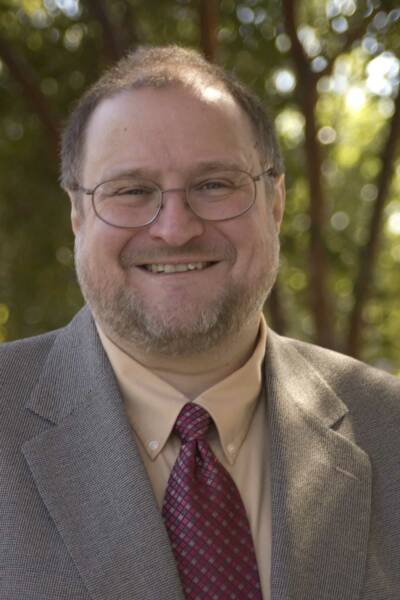
A licensed professional counselor in private practice in metro Atlanta, Darrell Grizzle is the author of I Never Meant to Start a Murder Cult and Other Stories.